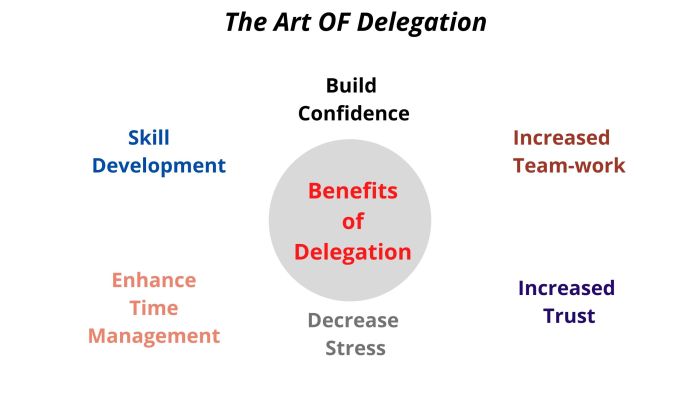
The art of delegation for business growth takes center stage as we delve into the key strategies and techniques essential for successful delegation in fostering business growth. Explore the world of delegation and its impact on productivity and decision-making.
In the following paragraphs, we will uncover the importance of delegation, effective strategies, challenges faced, and the significant impact delegation has on the growth of businesses.


Importance of Delegation in Business Growth

Delegation is a crucial aspect of business growth as it involves distributing tasks and responsibilities among employees or team members. By assigning tasks to individuals based on their skills and expertise, delegation allows leaders to focus on strategic decision-making and high-level responsibilities, leading to improved efficiency and productivity within the organization.
Examples of Successful Companies Embracing Delegation
- Google: Google’s success can be attributed in part to its delegation strategy, where the company empowers employees to take ownership of projects and make decisions autonomously.
- Amazon: Amazon’s founder and CEO, Jeff Bezos, is known for delegating tasks effectively, allowing the company to innovate and expand rapidly.
- Apple: Apple’s Steve Jobs was a master of delegation, trusting his team to execute his vision and bring revolutionary products to market.
Benefits of Delegation in Improving Productivity
Delegation can significantly enhance productivity within a business by:
- Reducing the workload of leaders, enabling them to focus on strategic planning and decision-making.
- Empowering employees to develop new skills and take on more responsibilities, leading to personal growth and increased job satisfaction.
- Improving efficiency by ensuring that tasks are completed by individuals with the appropriate expertise and resources.
How Delegation Leads to Better Decision-Making
Delegation contributes to better decision-making within a business by:
- Allowing leaders to allocate time and resources to critical decisions that have a significant impact on the organization’s growth and success.
- Leveraging the diverse skills and perspectives of team members to generate innovative ideas and solutions.
- Creating a culture of trust and collaboration, where employees feel valued and empowered to contribute their expertise to the decision-making process.
Strategies for Effective Delegation: The Art Of Delegation For Business Growth

Effective delegation is crucial for business growth as it allows leaders to focus on higher-level tasks and empowers team members to take ownership of their work. Here are some strategies to ensure successful delegation:
Identifying Tasks for Delegation, The art of delegation for business growth
When deciding which tasks to delegate, consider the following factors:
- Complexity: Delegate tasks that are within the capabilities of the team member.
- Impact: Delegate tasks that contribute to achieving overall business goals.
- Time Sensitivity: Delegate tasks that need to be completed within a specific timeframe.
Choosing the Right Team Members for Delegation
To select the most suitable team members for delegation, consider the following:
- Skills and Expertise: Match the task requirements with the team member’s skills and experience.
- Interest and Motivation: Choose team members who are interested in the task and motivated to excel.
- Workload: Ensure that the team member has the capacity to take on additional responsibilities.
Importance of Clear Communication
Clear communication is essential when delegating tasks to avoid misunderstandings and ensure successful outcomes. Tips for effective communication include:
- Provide clear instructions and expectations regarding the task.
- Encourage open dialogue for questions and clarifications.
- Establish regular check-ins to monitor progress and provide feedback.
Setting Expectations and Deadlines
To set clear expectations and deadlines for delegated tasks, consider the following:
- Define the scope of work, desired outcomes, and key deliverables.
- Agree on timelines and milestones to track progress.
- Clarify the level of autonomy and decision-making authority granted to the team member.
Overcoming Challenges in Delegation

Delegating tasks can be a powerful tool for business growth, but it comes with its own set of challenges. Identifying and overcoming these challenges is crucial for effective delegation and maximizing productivity within a team.
Common Challenges Faced When Delegating Tasks
Delegating tasks can be challenging due to various factors such as a lack of trust, fear of losing control, unclear expectations, and concerns about the quality of work delivered by the delegate. It is essential to address these challenges proactively to ensure successful delegation.
- Establish clear communication channels: Ensure that expectations, deadlines, and desired outcomes are communicated clearly to the delegate to avoid misunderstandings.
- Provide adequate training and support: Offer necessary training and resources to the delegate to empower them to complete the task effectively.
- Delegate based on strengths: Assign tasks to individuals based on their skills and strengths to increase the chances of successful completion.
- Encourage feedback and open communication: Create an environment where the delegate feels comfortable providing feedback and asking questions to clarify doubts.
Overcoming Resistance to Delegation
Resistance to delegation can stem from various reasons such as a fear of failure, lack of trust, or feeling overwhelmed with additional responsibilities. Overcoming this resistance requires a strategic approach to build trust and confidence in the delegation process.
- Start small: Begin by delegating smaller tasks to build trust and demonstrate the delegate’s capabilities.
- Provide positive reinforcement: Acknowledge and appreciate the delegate’s efforts and successes to boost their confidence and motivation.
- Offer support and guidance: Be available to provide guidance and support whenever needed to alleviate any concerns or doubts.
- Encourage autonomy: Allow the delegate to take ownership of the task and make decisions independently to foster a sense of responsibility.
Handling Micromanagement in Delegation Process
Micromanagement can hinder the delegation process by undermining trust and autonomy. It is essential to address micromanagement proactively to ensure a smooth delegation process and empower the delegate to work independently.
- Set clear expectations: Establish clear guidelines and expectations upfront to avoid the need for constant monitoring.
- Trust the delegate: Trust the delegate’s abilities and provide them with the freedom to execute the task in their way.
- Provide feedback constructively: Offer feedback in a constructive manner to guide the delegate without micromanaging their every move.
- Focus on outcomes: Shift the focus from the process to the outcomes to allow the delegate flexibility in achieving the desired results.
Dealing with Potential Errors or Mistakes in Delegated Tasks
Mistakes are inevitable in any work environment, but they can be particularly challenging when tasks are delegated. It is essential to handle errors or mistakes in a constructive manner to foster a culture of learning and growth within the team.
- Encourage open communication: Create a safe space for the delegate to report errors and discuss potential solutions without fear of reprimand.
- Provide constructive feedback: Offer feedback that focuses on areas of improvement and learning opportunities rather than placing blame.
- Implement corrective measures: Identify the root cause of the error and implement corrective measures to prevent similar mistakes in the future.
- Celebrate successes and learn from failures: Acknowledge successes and achievements while using mistakes as valuable learning experiences to improve processes and prevent recurrence.
Impact of Delegation on Business Growth
Delegation plays a crucial role in the growth and scalability of businesses. By effectively delegating tasks and responsibilities, business leaders can empower their employees, foster innovation, and free up valuable time to focus on strategic growth initiatives.
Contribution to Scaling a Business
Delegation is essential for scaling a business as it allows tasks to be distributed among team members, enabling the organization to handle increased workloads efficiently. Delegating responsibilities based on individual strengths and expertise ensures that tasks are completed effectively and promotes a more agile and adaptable work environment.
Fostering Innovation and Creativity
Delegation encourages employees to take ownership of their tasks and provides them with the autonomy to explore new ideas and approaches. By empowering employees to make decisions and implement creative solutions, businesses can drive innovation and foster a culture of continuous improvement. This not only enhances productivity but also leads to the development of new products, services, and processes.
Employee Empowerment through Delegation
Delegation can lead to employee empowerment by giving team members the opportunity to take on challenging projects and develop new skills. When employees are entrusted with responsibilities and given the freedom to make decisions, they feel valued and motivated to contribute to the success of the organization. This sense of empowerment boosts morale, enhances job satisfaction, and ultimately leads to higher levels of employee engagement and retention.
Time Management for Strategic Growth
Delegation allows business leaders to delegate routine tasks and day-to-day operations to their team, freeing up time to focus on long-term strategic goals and growth opportunities. By entrusting capable employees with operational responsibilities, leaders can concentrate on developing strategic plans, expanding market reach, and exploring new business ventures. This strategic focus is essential for driving sustainable growth and maintaining a competitive edge in the market.
Last Word
In conclusion, mastering the art of delegation is crucial for sustainable business growth. By implementing effective delegation strategies, businesses can enhance productivity, foster innovation, and empower their employees, ultimately freeing up time for strategic development.
Employee productivity is a crucial aspect of business success. One innovative way to improve employee productivity is by implementing flexible work schedules and remote work options. Studies have shown that employees who have the flexibility to work from home are often more productive and motivated.
By offering remote work opportunities, businesses can also save on overhead costs and reduce their carbon footprint. To learn more about innovative ways to improve employee productivity, visit Innovative ways to improve employee productivity.
The shift towards remote work has significantly impacted business operations. While some businesses have thrived with remote work models, others have faced challenges in maintaining communication and collaboration among team members. It is important for businesses to adapt to this new work environment by investing in technology that supports remote operations and by establishing clear communication protocols.
To understand more about the impact of remote work on business operations, visit Impact of remote work on business operations.
Sustainability is becoming increasingly important in business operations. Implementing sustainable practices not only benefits the environment but also enhances a company’s reputation and attracts environmentally-conscious consumers. Businesses can reduce waste, conserve resources, and promote social responsibility by integrating sustainable practices into their operations.
To explore more about implementing sustainable practices in business operations, visit Implementing sustainable practices in business operations.
